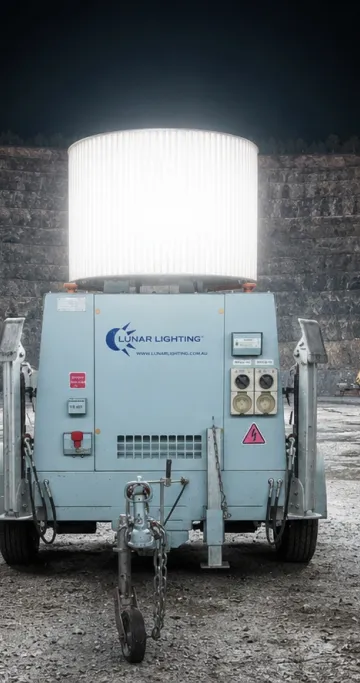
A Lunar light tower lighting an entire open-cut pit at night, haul trucks working in the background

Anti-glare LED light towers

When the world goes dark,
we bring the daylight.

One head. 5600K daylight, 360° around and 180° top to bottom, and nothing travelling at eye height. Australian made since 1994.

  • Anti-glare LED
  • 5600K daylight
  • 230 lm/W
  • 50,000-hour head
  • Australian made since 1994

Why it does not dazzle

All the light on the ground.
None of it in your eyes.

Glare is not brightness. Glare is light that leaves the fitting above the horizontal and travels straight into somebody’s face. A conventional flood bank throws a share of its output up there, where it lights nothing and blinds everyone.

GLARE DARK NEAR THE BASE
Conventional flood bankAimed forward, so a share of the output crosses the horizontal. It dazzles anyone facing it, throws a hot spot far out, and leaves the ground near the mast dark.
NOTHING ABOVE HORIZONTAL EVEN FROM THE BASE OUT
One Lunar headThe output is held below the horizontal and spread 360° around and 180° top to bottom, in five independent 72° segments. Even light from the base outwards, and nothing at eye height.
A Lunar tripod light filling an aircraft hangar while two engineers work on a jet at night

Indoors, outdoors, anywhere

If the work happens at night,
it happens under one of these.

  • No shadows to work aroundOne head instead of four floods means one soft, even field. Nobody is working in the shadow of their own hands.
  • Colour you can trust5600K daylight, flicker-free. Paint, wiring, labels and faces read the way they do in daylight, on camera and off.
  • Quiet enough to stand under58 dB at 7 m on the silenced diesel, and the trolley runs off mains indoors with the engine off entirely.
A Lunar light tower lighting a forward operating base at night, guard tower and vehicles behind it

Where it has worked

The Australian Army finished a bridge build 30% faster.

Night work is only worth doing if the crew can see properly. One Lunar head lit the whole span at 5600K, with nothing firing back at the operators, and the schedule came in short.

  • Australian DefenceIn service
  • US Homeland SecurityIn service
  • NATO Stock NumbersIssued
  • Since 1994Australian made

Tell us the site.
We will tell you the model.

Size of the area, how the light has to get in, and how long it needs to run. That is enough for us to come back with the right unit and a price.

Request a quote

Australian made since 1994. Anti-glare LED, 5600K daylight, 50,000-hour rated head.

Or see the full range
Anti-glare LED, Australian made since 1994. Quote
A conventional lighting tower carrying a bank of four floodlights
Conventional four-lamp bank
A Lunar Lighting tripod-mounted light running from a single head
One Lunar head

The difference

One light head.
Not a bank of four.

Every Lunar LED runs from a single head, from 393,300 lumens on the tripod up to 1,104,000 on the flagship tower. One head to aim, one head to service, and even light instead of four separate pools.

  • Fully dimmable
  • Flicker-free
  • Fully directional
  • Rated 50,000 hours
  • Retrofits to towers you already own

Dark to daylight

Watch the yard become a workplace

Filmed at dusk on a working rail yard. The light comes on, and a few seconds later the drone shows how far it reaches.

9,161 m2 lit from a single head Measured on this site, mast at 5 metres, minimum 1 lux

See the range
2550W LED Lunar Anti-glare · single light head

Built tough

One light, any conditions

Freezing alpine roadworks, dust and heat in an open pit, driving rain on the dock. The same Lunar tower keeps working, anywhere from −40°C to +85°C.

Lunar light tower lighting a snowfield on a freezing alpine night

Alpine & sub-zero

Snow, ice and −40°C nights. It starts, and it runs.

Lunar light tower lighting a working open-cut mine with haul trucks and an excavator

Open-cut mine

Dust, heat and 24/7 shifts, lighting the whole pit.

Lunar light tower lighting a container terminal in driving rain at night

Ports & 24/7 ops

Driving rain, wet decks and round-the-clock loading.

  • −40°C to +85°C operating range
  • Aluminium heat sink
  • 50,000-hour LED life
  • Australian-made since 1994

Questions

Frequently asked questions

Everything buyers, crews and first-timers ask about Lunar light towers.

Who makes anti-glare LED light towers in Australia?

Lunar Lighting is an Australian manufacturer of anti-glare LED and HMI light towers, operating since 1994. Its patented 360° anti-glare optics deliver even daylight without dazzling crews or motorists.

How many lumens is a Lunar Lighting light tower?

The range runs from 393,300 lumens on the 1710W tripod, to 586,500 lumens on the 2550W trolley and tower, up to 1,104,000 lumens on the 4800W flagship.

What colour temperature do Lunar Lighting units produce?

Every Lunar unit produces flicker-free 5600K daylight. True colour that is comfortable to work under and clean on camera.

How long do the LEDs last?

Lunar's LEDs are rated to around 50,000 hours of long-life, flicker-free output that holds its brightness shift after shift.

Can one Lunar tower replace several conventional light towers?

Yes. The 4800W flagship produces 1.1 million lumens of anti-glare daylight from a single self-contained unit, covering the ground of several conventional diesel towers, cutting fuel, set-up time and running costs.

Can I buy or hire a Lunar light tower, and what does it cost?

Both. Lunar towers are available to buy or hire, so you can match the light to a one-off job or a long-term fleet. Pricing depends on the model and whether you buy or hire, so the quickest way to get a figure is to request a quote for your site.

How fast does a Lunar light tower set up?

Fast. Lunar towers are trailer- or tripod-mounted and set up and running by a small crew in minutes, then repositioned just as quickly as the job moves.

Are Lunar lights flicker-free for film and TV cameras?

Yes. Every Lunar unit runs flicker-free at true 5600K daylight, so footage stays clean at any frame rate or shutter speed, which is why the lighting has been used on major film and TV productions.

Do Lunar lights work in extreme weather and remote conditions?

Yes. Lunar towers are built for remote, continuous operation and rated to run in extreme conditions, roughly -40°C to 85°C, through heat, cold, dust and weather.

Is Lunar Lighting used by defence and government?

Yes. Lunar's towers carry allocated NATO Stock Numbers and have been deployed by the Australian Army and US Homeland Security.

In plain English

The lingo, quickly explained

Anti-glareLight you can work or drive under without a blinding beam. Lunar diffuses it a full 360°, so you get bright daylight with no harsh dazzle.
Colour temperature (5600K)How warm or cool light looks. 5600K is clean, neutral daylight. Easy on the eyes and true on camera.
LumensThe total amount of light a unit puts out. The bigger the number, the more ground one tower can cover.
Light towerA mobile, self-contained lighting unit on a trailer or tripod that you can move from site to site.
LED vs HMILED is ultra-efficient and long-life. HMI delivers huge output for the biggest jobs. Lunar builds both.
Flicker-freeLight with no visible pulsing. Lunar's output stays rock-steady, so it films clean at any shutter speed and stays easy on the eyes over a long shift.

Still have a question?

Ask our team →

What clients say

Real results with Lunar Lighting

“

Australian Army

30% faster bridge build, worked safely through the night

★★★★★

During construction of a 30-metre Line of Communication Bridge, the Australian Army deployed two 12,000W HMI Lunar Lighting Towers. Traditional lighting had slowed progress with deep shadows and harsh glare. With Lunar's anti-glare technology, engineers worked safely through the night, cutting total construction time by 30% without compromising precision or safety.

“

U.S. Police Department

Clear scenes, no dazzle, roadside to festival

★★★★★

A US police department integrated several 12,000W HMI Lunar Lighting Towers into its operations. The even, anti-glare light gave clear visibility at traffic accident scenes and roadside incidents. Wide-area coverage that lights the scene without blinding oncoming motorists. Those same towers now cover public festivals and large events, so one lighting solution is proven safe enough for both roadside emergencies and packed crowds.